EvenUp: Flipping the Table on Unfair Injury Settlements with Legal AI EvenUp: 불공정한 협상 테이블을 뒤집는 리걸테크 AI
Introducing EvenUp, the AI startup rewriting the rules of personal injury law.개인 상해 법률 시장의 판을 바꾸고 있는 AI 스타트업

A problem born from one accident
In January 2025, the AI startup EvenUp launched a new legal document tool called Express Demands. Trained on hundreds of thousands of cases and millions of medical records, it turns accident-related paperwork into a settlement demand letter in minutes.
Co-founder Rami Mishaeniets’ father was permanently disabled in a car accident. Under the pressure of mounting medical bills, the family settled quickly with the insurer — for less than half of what similar cases were worth.
Ninety-nine percent of personal injury claims filed each year are settled privately, without ever reaching trial. Yet victims and their lawyers rarely have a clear sense of what their case is actually worth, which is exactly why settlements for similar injuries can differ by multiples, as in Mishaeniets’ own case. Insurers, by contrast, have vast data and dedicated staff to price a case precisely — giving them the upper hand before negotiations even begin. That gap widens further for smaller, resource-strapped firms.
The founding of EvenUp
CEO Rami Karabiba, COO Raymond Mishaeniets, and CPO Sam Marshad — a former trial lawyer — founded EvenUp to correct this imbalance. The name itself carries the mission: to “even up” the field. EvenUp set out to build a world where every personal injury case can access justice equally, regardless of a person’s background, income, or the quality of legal representation they can afford.
EvenUp’s AI doesn’t just speed up a lawyer’s work — by providing precise data and evidence, it lets small and mid-sized firms negotiate on equal footing with large insurers. One family’s unfair experience has grown into technology reshaping fairness across an entire industry.
The mission is already showing results. Since launching in January 2025, EvenUp has signed on more than 30% of the top 100 personal injury firms in the US, and now processes over 10,000 cases a week, representing more than $14 billion in total claim value. Reflecting on the company’s origins during the Series B announcement, Mishaeniets said:
“Our family’s fight for justice and fair compensation in the wake of a tragic accident exposed the flaws in the existing system. By harnessing the power of technology, we can build a future where the pursuit of justice isn’t dictated by financial pressure or a lawyer’s resources.”
— Bessemer Venture Partners, EvenUp Series B Announcement
Piai™, EvenUp’s personal injury AI
Behind this outcome is Piai™, EvenUp’s purpose-built AI for personal injury cases — trained on more than 100,000 case records, a million medical records, and the daily supervision of over 150 medical and legal experts.
A single personal injury case can involve hundreds or thousands of pages of medical records — handwritten notes, scans, and checkbox forms mixed together, difficult even for a person to parse, let alone a general-purpose AI model. Piai™ processes this messy material in three steps.
The first step is complex data extraction. Piai™ reads handwritten notes, scanned documents, and checkbox-style medical forms, pulling out the actual treatment history. It structures unstructured medical records that general language models typically fail to interpret correctly. The second step is automatic reconciliation: treatment records from multiple hospitals and physicians are merged into a single timeline, surfacing contradictions or missing information along the way, while filtering out anything unrelated to actual treatment — avoiding a common failure mode of general-purpose AI. The final step is case-grounded output: from thousands of pages, Piai™ pinpoints the medical, liability, and damages information that matters, and applies a firm’s own conventions and best practices to the drafting. The result is grounded not in generic information from the internet, but in the firm’s accumulated knowledge and the case’s own evidence. The diagram below shows how these three steps connect.
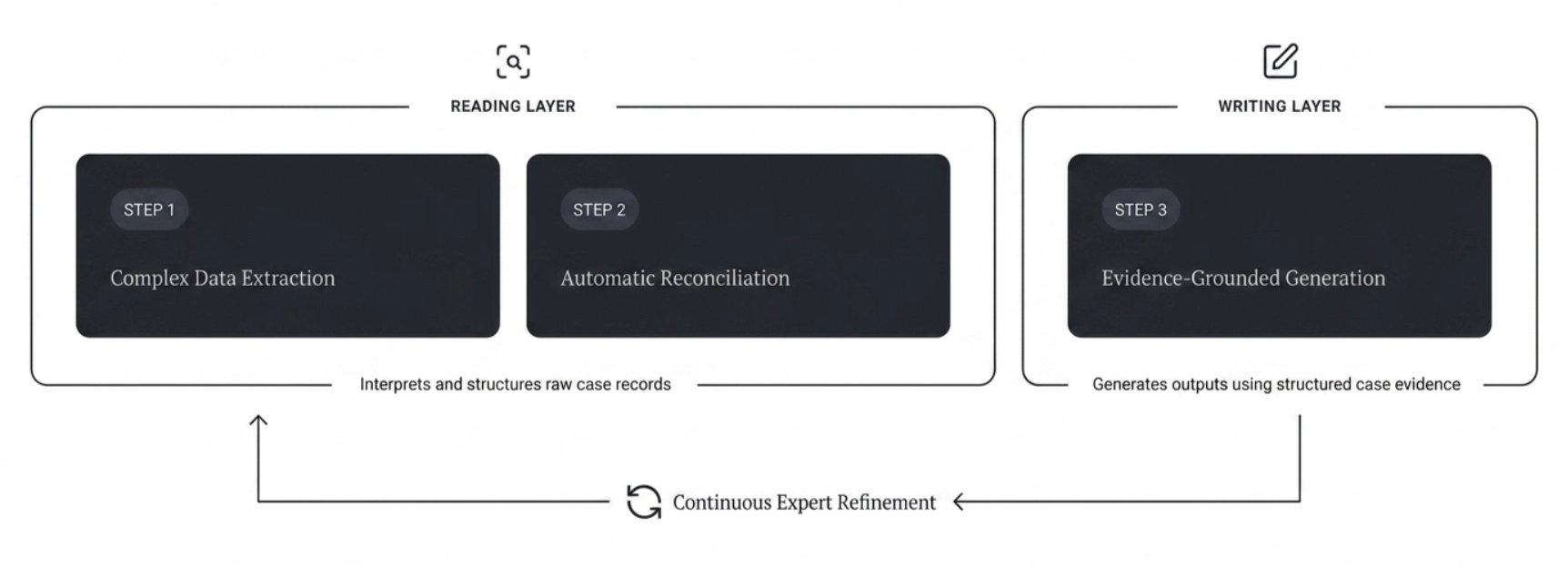
Diagram reworked from EvenUp’s official site: Reading Layer (Steps 1–2) → Writing Layer (Step 3), with Continuous Expert Refinement.
Beyond processing large, complex documents, Piai™ also handles repetitive work: gathering medical records and bills, drafting demand letters, and following up on treatment status or outstanding balances. When a lawyer needs a piece of information mid-case, there’s no need to dig through case files — they can simply ask, as if querying an assistant that remembers every detail of the case. Piai™ ends up being less a document tool and more a presence that lifts the repetitive, draining work off a lawyer’s plate.
Why Piai™ doesn’t make things up — Smart Citations
Piai™’s output is trustworthy because every sentence is designed to trace back precisely to the case’s actual evidence. The biggest risk with AI-generated writing is that it fabricates facts — what’s known as “hallucination.” AI can also drift from legally required formats. To keep its writing strictly fact-based, EvenUp uses a feature called Smart Citations. Every claim, treatment detail, and legal basis in a generated document is linked to the exact line of the source document it came from. If the AI writes “this person received this treatment,” you can verify precisely which document, and which line, that came from. Smart Citations runs on RAG technology.
RAG, or Retrieval-Augmented Generation, works in two stages to keep AI from inventing content. The first is retrieval: before answering, the AI first fetches relevant material — a case summary, medical records, whatever actually exists. The second is generation: rather than writing freely from what it already “knows,” the AI writes only from what it just retrieved, following the rule “write only from what’s in this material.”
This sharply reduces the odds of AI fabricating unsupported claims, and makes it possible to trace which source backs which sentence — including how an accident happened and how severe the injuries were. In an information environment as large and multi-modal as text, images, and tables combined, conventional RAG can struggle to retrieve evidence reliably. Industry and academia are both working on more reliable RAG techniques, and EvenUp combines several proven approaches into its own system.
So how does EvenUp actually find trustworthy evidence?
Given how large and multi-modal case files are, how does EvenUp reliably pull out accurate evidence? The answer lies in three systems it has built: the System of Record, the System of Intelligence, and the System of Action.
The old approach was “top-down” — every question was answered from scratch. A personal injury case file can run thousands of pages, so even a simple question like “What’s the total billed amount from Provider X?” or “How many visits to Clinic Y?” meant searching the entire file every time. Gathering data on the fly, every time, was slow, expensive, and error-prone. Once a fact was established, it wasn’t kept in a reusable, verifiable form — that was the missing piece. The System of Record fills that gap.
1 System of Record
Intake doesn’t stop at text. EvenUp standardizes everything coming in — PDFs, scans, handwritten notes, tables, images. Visual material goes through the reinforcement-learning process described earlier to become an accurate description, then is linked back to its original page position and stored alongside the text.
From this standardized material, the system builds out case entities — claimants, providers, visits, procedures, billed line items, vehicles, accident scenes — their relationships, and a timeline. Every entry carries a source link and model version, and any human correction is recorded as part of that record.
2 System of Intelligence
This is the layer where questions are answered against the structured record, not the raw pages. Once the record exists, the system routes each question by type: factual lookups pull straight from the record, while questions needing context or reasoning trigger a fresh search of the original documents. Every answer cites both the relevant record entry and the exact document or image region backing it.
As a result, a question like “How many times did the plaintiff visit Clinic Y?” becomes a simple record lookup instead of re-reading thousands of pages, while a question like “Explain the sequence of events at the time of the collision” returns a structured scene summary along with the diagrams that support it.
3 System of Action
Once the record exists, action follows naturally — and leaves a trail. Because facts are already organized, it’s clear what’s missing and what to do next. Missing records can be requested from the relevant provider, and outreach or demand-letter drafts can be written directly from recorded facts and cited evidence. Stakeholders can be notified at the right time, based on the timeline and confidence level.
Every action is logged with its inputs, outputs, and approvals. When uncertainty is high or conditions aren’t met, the system asks a human for input and remembers the answer for future planning.
To sum up the core flow: the System of Record locks in trustworthy facts, the System of Intelligence plans how to combine querying, retrieval, and generation, and the System of Action carries it out safely while leaving an audit trail.
Under the old top-down approach, every aggregate figure had to be recalculated from the raw pages each time, making verification difficult. With a record built up front, the same question becomes far simpler and verifiable — closer to querying an organized database than improvising an answer each time. A provenance graph shows exactly where a number came from and which document supports it. That’s where the trust comes from.
Where EvenUp goes from here
What EvenUp demonstrates is one answer to the question: how do you close an information asymmetry? The data-and-headcount advantage insurers have long held is gradually narrowing, through Piai™’s document processing, Smart Citations, and the three-layer architecture of record, intelligence, and action. If the negotiating table used to reward whoever could organize their evidence fastest, EvenUp is trying to rewrite the rules of that contest altogether.
What’s notable is that this shift didn’t start from a grand thesis — it started from one family’s personal sense of injustice. In a legal market long seen as conservative and analog, the ability to read massive volumes of documents accurately and trace every claim back to its evidence turned out to be exactly what was needed.
It’s also worth noting that this is still very much in motion. More than 30% of the top 100 personal injury firms in the US have already adopted EvenUp, and the cases it processes weekly now represent over $14 billion in value. One founder’s unfair experience is growing into infrastructure reshaping negotiation practices across an entire industry — worth watching closely as it continues to unfold.
하나의 사고에서 시작된 문제의식
2025년 1월, AI 스타트업 EvenUp이 새로운 법률 문서 생성 도구 ‘Express Demands’를 공개했다. 이 도구는 수십만 건의 사건과 수백만 건의 의료 기록을 학습한 AI를 기반으로 사고 관련 서류들을 몇 분 만에 합의금 청구서로 만들어준다.
공동 창업자 레이먼드 미샤니에츠의 아버지는 자동차 사고로 영구 장애를 입었고, 늘어나는 병원비를 감당해야 한다는 압박감 속에 서둘러 보험사와 합의했다. 그 당시 받은 합의금은 유사한 사건의 적정 합의금의 절반도 되지 않았다.
매년 접수되는 손해배상 청구의 99%가 재판 없이 사적 합의로 끝나지만, 정작 피해자와 변호사는 자신의 사건의 적정 합의금이 얼마인지 가늠하기 어렵다. 레이먼드 미샤니에츠의 사례처럼 비슷한 부상을 입고도 합의금이 몇 배씩 차이 나는 일이 벌어지는 이유다. 반면 보험사는 방대한 데이터와 전담 인력을 갖추고 사건 가치를 정교하게 산정할 수 있어, 협상 테이블에서부터 이미 우위를 점한다. 자원이 부족한 중소형 로펌일수록 이 격차는 더 크게 벌어진다.
EvenUp의 탄생
CEO 라미 카라비바, COO 레이먼드 미샤니에츠, CPO이자 전직 소송 변호사인 쌤 마샤드, 세 사람은 이 불균형한 구조를 바로잡겠다는 목표로 EvenUp을 세웠다. 회사 이름(EvenUp)부터가 ‘평등하게 만들다’는 뜻을 담고 있다. EvenUp은 개인의 배경이나 소득 수준, 얼마나 좋은 변호인단을 구할 수 있는지에 상관없이 모든 개인 상해 사건이 사법 정의에 동등하게 접근할 수 있는 세상을 만들겠다는 결심으로부터 시작했다.
EvenUp의 AI는 변호사의 업무 속도를 높이는 데 그치지 않고 정밀한 데이터와 근거를 제공함으로써 중소형 로펌도 거대 보험사와 대등한 조건에서 협상할 수 있도록 돕는다. 한 가족이 겪은 불공정한 경험이, 이제는 업계 전체의 공정성을 바꾸는 기술로 이어지고 있는 셈이다.
이러한 미션은 실제 성과로도 이어지고 있다. 2025년 1월 서비스를 처음 선보인 EvenUp은 현재 미국 상위 100대 인적 피해 로펌 중 30% 이상을 고객으로 확보했으며, 매주 10,000건이 넘는 사건(총 피해 규모 140억 달러 이상)을 처리하는 기업으로 성장했다. 레이먼드 미샤니에츠는 Series B 투자 발표에서 창업 계기를 다음과 같이 회고했다.
“비극적인 사고 앞에서 정의와 공정한 보상을 위해 싸웠던 우리 가족의 투쟁은 기존 시스템의 결함을 여실히 보여주었습니다. 기술의 잠재력을 활용함으로써, 우리는 정의를 구하는 과정이 경제적 압박이나 변호사의 역량에 의해 좌우되지 않는 미래를 만들 수 있습니다.”
— Bessemer Venture Partners, EvenUp Series B Announcement 중
EvenUp의 개인 상해 전문 AI, Piai™
이처럼 개인적 경험에서 출발한 문제의식이 실질적인 성과로 이어질 수 있었던 배경에는 EvenUp이 자체 개발한 개인상해 전문 AI ‘Piai™’가 있다. Piai™은 10만 건 이상의 개인상해 사건 기록과 100만 건의 의료 기록, 그리고 매일 AI를 지도학습하는 150명 이상의 의료·법률 전문가를 바탕으로 만들어진 개인상해 전문 AI다.
개인상해 사건 하나에는 수백에서 수천 페이지에 달하는 의료 기록이 따라붙는다. 손글씨 메모, 스캔본, 체크박스로 채워진 진료 양식까지 뒤섞여 있어 사람이 읽기에도 벅차고, 일반적인 AI 모델이 다루기에도 만만치 않다. Piai™는 이 지저분한 자료를 세 단계에 걸쳐 처리한다.
첫 단계는 복잡한 데이터 추출이다. Piai™는 손글씨 메모나 스캔 문서, 체크박스 형식의 진료 기록까지 읽어내고, 그 안에서 실제 치료 내역을 그대로 뽑아낸다. 일반 언어모델이 제대로 해석하지 못하는 비정형 의료 기록도 구조화된 형태로 정리해낸다. 두 번째 단계는 자동 대조다. 여러 병원과 의사에게서 받은 치료 기록을 하나의 시간 흐름으로 통합하고, 그 과정에서 드러나는 모순이나 빠진 정보를 미리 찾아낸다. 또한 실제 치료와 무관한 내용을 구분하여 범용 AI가 흔히 저지르는 오류를 피한다. 마지막 단계는 사건에 근거한 결과 도출이다. 수천 페이지의 기록 속에서 의료·과실·손해배상과 관련된 핵심 정보를 짚어내고, 로펌의 기존 관행과 모범 사례에 맞춘 작성 가이드를 적용한다. 이렇게 만들어진 결과물은 인터넷의 일반 정보가 아니라, 로펌이 축적해온 지식과 사건 자체의 증거에 근거한다. 아래 그림은 이 세 단계가 어떻게 이어지는지를 보여준다.
공식홈페이지 사진 재가공 다이어그램: Reading Layer(Step 1~2) → Writing Layer(Step 3), Continuous Expert Refinement
Piai™는 방대하고 복잡한 문서 처리 외에도 진료 기록과 병원비 영수증을 모으고, 치료비를 청구하는 문서의 초안을 쓰고, 치료 경과를 확인하거나 남은 병원비를 파악하는 것과 같은 반복적인 연락 업무까지 대신 처리해준다. 변호사가 중간에 어떤 정보가 필요할 때도 마찬가지다. 수많은 사건 자료를 일일이 뒤져 정리할 필요 없이 사건의 모든 내용을 기억하고 있는 비서에게 묻듯 질문만 던지면 바로 답을 얻을 수 있다. Piai™는 결국 문서를 만들어주는 도구를 넘어 변호사 곁에서 반복적이고 소모적인 업무를 덜어주는 존재에 가깝다.
Piai™가 거짓말을 하지 않는 이유 - 스마트 인용(Smart Citations)
Piai™가 만들어내는 결과물이 신뢰받을 수 있는 이유는 모든 문장이 실제 사건 근거와 정확히 연결되도록 설계되었기 때문이다. AI가 글을 써줄 때 가장 걱정되는 것은 사실이 아닌 내용을 지어내는 것이다. 이것을 “할루시네이션(hallucination)”이라고 부른다. 또한 AI는 법적으로 정해진 형식에서 벗어난 문서를 쓸 위험도 있다. EvenUp은 AI가 사실에 기반한 글만 쓰도록 “스마트 인용(Smart Citations)”이라는 기능을 사용한다. AI가 문서를 쓸 때 주장하는 내용, 치료 내역, 법적인 근거까지 모든 문장이 실제 사건 문서의 정확한 줄까지 연결되어 표시된다. 즉 AI가 “이 사람은 이런 치료를 받았다”라고 쓰면 그 내용이 실제로 어떤 문서의 몇 번째 줄에서 나온 것인지 바로 확인할 수 있다. 이러한 스마트 인용 기능은 RAG 기술을 사용한다.
RAG는 “검색 증강 생성”이라는 뜻을 가진 기술이다. 이 기술은 AI가 이야기를 지어내지 않도록 두 단계로 나누어 작업한다. 첫 번째는 검색 단계다. AI가 답을 하기 전에 먼저 관련 자료를 찾아온다. 어떤 사건에 대한 문서를 써야 한다면 그 사건의 요약 자료나 진료 기록처럼 실제로 존재하는 자료를 먼저 가져오는 것이다. 두 번째는 생성 단계다. AI는 원래 알고 있던 내용을 마음대로 쓰는 대신 방금 찾아온 자료만 보고 문장을 쓴다. “이 자료에 있는 내용만 가지고 글을 써라”는 규칙을 지키는 셈이다.
이 방식을 쓰면 AI가 근거 없는 이야기를 지어낼 가능성이 크게 줄고 어떤 자료를 보고 쓴 문장인지도 확인할 수 있다. 사고가 어떻게 일어났고 얼마나 다쳤는지를 글로 옮길 때도 AI가 실제 사건 자료만 참고해 정확하게 쓸 수 있게 되는 이유다. 텍스트·이미지·표 등 다중 모달 데이터로 구성된 방대한 정보 환경에서 기존 RAG 기술은 정확한 근거 검색의 안정성이 떨어질 수 있다. 이를 해결하고자 산업계와 학계는 RAG의 신뢰성을 높이는 기술을 연구하고 있으며 검증된 주요 기술들을 상호 보완적으로 조합하여 EvenUp 시스템에 구현하고 있다.
그래서 EvenUp은 어떻게 신뢰할 수 있는 근거를 찾아내는가
그렇다면 이렇게 방대하고 복잡한 다중 모달 사건 자료 속에서 EvenUp은 실제로 어떻게 안정적으로 정확한 근거를 찾아낼까. 그 답은 EvenUp이 구축한 세 개의 시스템, 즉 기록 시스템, 지능 시스템, 실행 시스템에 있다.
기존 방식은 질문마다 처음부터 다시 답을 찾는 ‘탑다운’ 방식이었다. 개인상해 사건 문서는 수천 페이지에 달할 수 있는데, “X 의료기관의 총 청구액”이나 “Y 클리닉 방문 횟수”처럼 단순한 질문조차 사건 파일 전체를 일일이 뒤져야 했다. 매번 즉석에서 데이터를 모으다 보니 느리고, 비용이 많이 들고, 오류도 잦았다. 사실이 한 번 정리된 뒤에도 꺼내 쓸 수 있고 검증할 수 있는 형태로 남아 있지 않다는 것, 이것이 빠져 있던 부분이었다. 그 빈자리를 채우는 것이 바로 다음에 소개되는 기록 시스템이다.
1 기록 시스템 (System of Record)
입고 단계부터 텍스트에만 머무르지 않는다. EvenUp은 PDF, 스캔본, 자필 메모, 표, 이미지 등 들어오는 자료를 모두 표준화한다. 이미지 같은 시각 자료는 앞서 설명한 강화학습 방식을 거쳐 정확한 설명으로 한 번 변환된 뒤, 원래 있던 페이지 위치에 연결되어 텍스트와 함께 저장된다.
이렇게 정리된 자료를 바탕으로 청구인, 의료기관, 진료 건, 시술, 명세 항목, 차량이나 사고 현장 같은 사건 요소들과 이들 간의 관계, 그리고 시간 순서(타임라인)를 구축한다. 모든 항목에는 출처 링크와 모델 버전이 함께 남고, 사람이 값을 수정하면 그 수정 이력도 기록의 일부로 남는다.
2 지능 시스템 (System of Intelligence)
질문이 원본 페이지가 아니라 이렇게 정리된 ‘기록’을 대상으로 답을 찾도록 하는 단계다. 기록이 갖춰지면 시스템은 질문의 성격에 따라 방식을 나눈다. 사실 확인이 필요한 부분은 기록에서 곧바로 답을 가져오고, 맥락이나 논리가 필요한 부분은 원본 문서를 다시 검색한다. 답변에는 기록의 해당 항목과 함께, 이를 뒷받침하는 정확한 문서 영역이나 이미지 영역이 같이 인용된다.
그 결과 “원고가 Y 클리닉을 몇 번 방문했는가?” 같은 질문은 수천 페이지를 다시 읽는 일이 아니라 정리된 기록을 조회하는 간단한 작업이 되고, “충돌 당시 사건 순서를 설명하라” 같은 질문에는 구조화된 현장 요약과 이를 뒷받침하는 도면 자료가 함께 제시된다.
3 실행 시스템 (System of Action)
기록이 갖춰지면 그다음 실행은 자연스럽게 이어지고, 흔적도 남는다. 사실이 기록에 정리돼 있으니 무엇이 빠졌고 다음에 무엇을 해야 하는지도 명확해진다. 빠진 기록은 해당 의료기관에 요청할 수 있고, 외부 연락이나 청구서 초안도 기록된 사실과 인용된 근거를 바탕으로 작성할 수 있다. 이해관계자들에게는 타임라인과 신뢰도에 맞춰 적절한 시점에 알림을 보낼 수도 있다.
각 실행은 입력값, 결과, 승인 내역과 함께 기록으로 남는다. 불확실성이 크거나 조건이 맞지 않을 경우에는 시스템이 사람에게 도움을 요청하고 그 답을 기억해 다음 계획에 반영한다.
지금까지의 핵심 흐름을 정리하면 이렇다. 기록 시스템이 신뢰할 수 있는 사실을 고정하고, 지능 시스템이 질의와 검색, 생성을 어떻게 조합할지 계획하며, 실행 시스템이 이를 안전하게 실행하고 감사 내역을 남긴다.
기존의 탑다운 방식에서는 모든 집계 데이터를 매번 원본 페이지에서 다시 계산해야 해서 검증이 어려웠다. 반면 기록을 먼저 갖춰두는 방식에서는 같은 질문도 훨씬 단순하고 검증 가능해진다. 즉흥적인 대응이라기보다 정리된 데이터베이스에 쿼리를 던지는 것에 가깝고 출처 그래프를 보면 어떤 수치가 어디서 나왔는지, 어떤 문서가 이를 뒷받침하는지 정확히 알 수 있다. 신뢰는 바로 이런 과정에서 쌓인다.
EvenUp이 그리는 다음 그림
EvenUp이 보여주는 것은 결국 “정보의 비대칭을 어떻게 해소할 것인가?”라는 질문에 대한 하나의 답이다. 보험사가 오랫동안 누려온 데이터와 인력의 우위는 이제 Piai™의 문서 처리 능력과 스마트 인용, 그리고 기록·지능·실행이라는 세 겹의 구조를 통해 조금씩 좁혀지고 있다. 협상 테이블에서 누가 더 많은 자료를 빨리 정리할 수 있는가의 싸움이었다면 EvenUp은 그 싸움의 규칙 자체를 바꾸려 하고 있는 셈이다.
흥미로운 지점은 이 변화가 거창한 담론이 아니라 한 가족이 겪었던 개인적인 억울함에서 출발했다는 사실이다. 오랫동안 보수적이고 아날로그적이라 여겨졌던 법률 시장에서 방대한 문서를 정확하게 읽어내고 근거를 추적하는 AI의 역량이 오히려 가장 절실하게 필요했던 셈이다. EvenUp은 기술이 낯선 산업에 이식되었을 때 어떤 방식으로 뿌리내릴 수 있는지를 보여주는 사례에 가깝다.
무엇보다 이 흐름은 아직 진행 중이라는 점에 주목할 만하다. 미국 상위 100대 인적 피해 로펌 중 30% 이상이 이미 EvenUp을 도입했고 매주 처리되는 사건 규모는 140억 달러를 넘어선다. 한 명의 창업자가 겪은 불공정한 경험이 이제는 업계 전반의 협상 관행을 재구성하는 인프라로 자라나고 있다는 점에서 EvenUp의 다음 행보를 계속 지켜볼 필요가 있다.